Gabriel Garcia Marquez is a Colombian author. He’s usually associated with “magic realism”, a feature used in many of his books. His most famous book is One Hundred Years of Solitude.
Characters (red characters are not the most important ones but could be fancy to mention during an oral)
Florentino Ariza: protagonist, manipulative man who loves Fermina and has many sexual relationships with other women, he sometimes gets paid to write love letters for others
Fermina Daza/Urbino: Florentino’s love interest, a fierce girl then housewife who marries Dr Urbino and fears aging
Dr Juneval Urbino: Fermina’s spouse, an older man who loves Fermina and asked her dad to marry her, has an affair with a prostitute when he’s old because he wants to spice up his life, dies as he falls from a ladder
Aunt Escolastica: Fermina’s aunt, she acts as a motherly figure and takes care of Fermina as a teenager, she encourages Florentino and Fermina’s affair as she taught her niece that love is something which has many rules of appropriate behavior but sometimes should go against these same rules
Lorenzo Daza: Fermina’s father, disapproves of Fermina’s love affair and sends her away to forget Florentino, he marries her to Urbino for money and escapes town after many rumors on him being a thief
Florentino’s mother: Florentino’s mother and confident, only person he tells his love for Fermina to, turns senile and dies
Fermina’s cousin: Fermina’s confident, encourages her to have a relationship with Florentino
America: one of Florentino’s affair, a 14 y.o. girl Florentino is in charge of
Leona Cassiani: only black woman in the play, also the only woman Florentino doesn’t succeed in to seducing, she takes care of Florentino in his old age and works in the same company as him
Rosalba: a pregnant woman who sleeps with Florentino on a boat and takes his virginity
Jeremiah de Saint Amour kills himself because he fears aging
Summary (LITTOC is a book wrote in reconstruction, but here I’ve organized it)
Florentino is in love with Fermina. He plays her violin to seduce her from afar and transmits her love letters during her classes with Escolastica. She falls in love with him and Florentino then gets the courage to ask her to wed. Her father discovers the love letters and takes her on a trip with her to forget the teenager. She then comes back years later and rejects Florentino. Florentino remains sad and keeps watching Fermina from afar her whole life. She, on the other hand, marries Dr Urbino whom her father wanted her to wed because of his wealth. They both go on a cruise in Europe where she loses her virginity. She lives a pleasant and happy life and has many kids. Florentino encounters many women and has many affairs which end in disaster as most of his partners are married (also, he kind of acts like a pervert and manipulative man who destroys lives). As he wants to be worthy of Fermina, he works hard and achieves a successful career.
Dr Urbino starts aging and has a brief affair as he wants to change his habits. However, Fermina discovers it because of his smell, therefore Urbino has to admit everything and begs her to forgive him. Dr Urbino then dies as he tries to get back his bird who tried to flee. Fermina grieves and Florentino starts appearing back in her life. He asks her to join her on a cruise and finally live the life they’ve always wanted. She finally accepts and they both get on the boat. They finally have sex as elderly people and are able to fall in love once again. The boat then can’t land as cholera is infesting cities and the cruise seems to be endless.
Themes
Love, aging, manipulation and death
Main stylistic devices
-magic realism
-diction of decay
-epistolary
-symbolism
-allegory
Quotes(underlined stuff is what to memorize)
. “Fermina Daza bathed her husband just as if he were a new born child” Aging comparison, binary opposition
. “he dared to explore her withered neck with his fingertips…her hips with their decaying bones, her thighs with their aging veins.” Agingdiction of decay, surprising pejorative description of the loved one
. “There was no greater glory than to die for love” DeathForeshadowing, hyperbole
.“Nothing resemblesaperson as much as thewayhedies.”Deathhyperbole, mournful tone, assertive
. “I’ve remained a virgin for you.” Love metaphor for his heart and feelings, deeper meaning what Florentino says to Fermina on the cruise
. “Only God knows how much I loved you.” Love Religious diction, divine state, lack of communication Urbino’s last words
. “The heart’s memory eliminates the bad and magnifies the good.” Manipulationpersonnification, moral diction, blinding love
. “Don’t fall into my little trap” Manipulation Metaphor, euphemism Marquez
.”My heart has more rooms than a whorehouse.”Florentino’s anger and perception of himself Metaphor, comparison
. “The world is divided into those who canshit and those whocannot”
Advice from an elder colloquial tone, disturbing imagery, binary opposition
This theme highlights the importance of seas and oceans in the process of globalization today.The maritimization of economies and the opening of international trade give seas and oceans a fundamental role in the supply of resources (halieutics, energy, biochemicals), and in material and immaterial exchanges. However, the relative importance of roads/routes and itineraries differ according to the nature of the flows (raw materials, intermediate products, industrial, information). Furthermore, territories are unequally integrated into globalization. Sea routes and submarine cables, as well as harbours and areas of exploitation are concentrated on a few main axes.
However, major changes are taking place that increase the geostrategic stakes and power rivalries, especially around channels and international straits. The development and use of the seas and oceans manifest tensions between contradictory objectives, such as the desire for exclusive rights/ control and the freedom of movement or exploitation of natural resources versus conservation. This explains in large part why the demarcation of exclusive economic zones(EEZs) is today the main cause of tension between states competing over the resources present in these areas and the desire of these states to exploit these resources.
Obligatory Reading: PRISONERS OF GEOGRAPHY CHAPTERS ON China, United States and The Arctic.
Polymetallic nodules, also called manganese nodules, are. rock concretions which can contain contain metals such as cobalt, nickel, copper, lithium, and manganese. They take around 1 million years to grow 2-15mm in size and are very valuable – although the equipment used to recover them also costs a great deal.
Understanding the difference between blue water and green water navies:
Example of tensions over ecological issues – whaling: case study of Paul Watson and Sea Shepherd:
Sea Shepherd founder Paul Watson says Japan seeking to make an example of him (Sept 2024):
Anti-whaling activist Paul Watson has said that authorities in Tokyo are seeking to make an example of him, as he awaits a possible extradition to Japan, while in detention in a Greenland prison.
Speaking to the AFP news agency, the 73-year-old US-Canadian campaigner said his time behind bars has not prevented him from continuing his fight to save whales.
Example of China engaging in illegal fishing in the Pacific:
Chinese Fishing Fleet under the Limelight in Latin American Waters
The massive presence of the Chinese fishing fleet in the waters of Latin America has contributed to making China one of the world’s leading seafood exporters, but also the worst when it comes to illegal, unreported, and unregulated (IUU) fishing. The situation took a turn in late 2023 as Chinese vessels have been subjected to inspections from the U.S. Coast Guard and partner nations to address their questionable practices in the Pacific Ocean, NBC News reported.
China’s expanding navy (BBC News article Sept 2025):
https://www.bbc.com/news/articles/c4gmnpg31xlo
Chapter 2: Comparing France and the USA in terms of Maritime Power
For both the US and France, seas and oceans have economic, environmental and geostrategic importance. France and the United States control the two largest exclusive economic zones (EEZs), (even though the US has not ratified the UNCLOS), and they assert their respective maritime power despite the loss of competitiveness of their ports. On the one hand, this topic focuses on the economic role of maritime spaces, especially with regard to resources, the flows of goods and information. On the other hand, it is important to examine the military and diplomatic aspects of maritime power exercised by France and the United States.
This is the key booklet for this comparative study of French and US maritime power:
Link to introduction and overview video for chapter 1 and chapter 2 (USA):
Introduction
This theme studies how contemporary globalization leads to the assertion or confirmation of existing powerful actors and the emergence of new ones. Territories, regardless of the scale considered (states, infra- and supra-state regions, or metropolises) have unequal access to globalization. The effects of distance and trade barriers (protectionism), which limit international trade (and globalization) will be studied in addition to a country study of the USA: The United States, a country in globalization: unequal integration of territories, tensions and international cooperation and France:differentiated international influence and unequal attractiveness in globalization.
Key Questions
General Question: Why are different territories unequally integrated into globalization?
General Question: Analyze cooperation, tensions, and regulations at the global, regional, and local scales.
In what ways are (U.S.) territories unequally integrated into globalization?
How does cooperation among actors affect globalization?
What trade-related tensions surround globalization (at global, regional, local levels)?
To what extent do regulations influence globalization?
France – To what extent is France a global power? To what extent does it attract or miss out on global flows?
Learning Objectives
❖ Identify the various actors involved in processes of globalization.
❖ Understand how globalization leads to shifts among actors and the emergence of new actors (e.g., countries or TNCs).
❖ Analyze the consequences of globalization on the U.S. at local, regional, and global scales.
❖ Evaluate the European Union’s interactions on continental and global scales
❖ Apply a multi-scale (global-regional-local) analysis to globalization processes.
❖ Evaluate territories at different scales to recognize that they do not all benefit from equal access to globalization.
❖ Analyze the impact and integration of France in globalization.
UPDATE: Articles on Aukus Treaty as example of international cooperation and tension:
Trading blocs play a significant part in shaping the global economy. They grease indigenous integration, enhance trade volumes, stimulate profitable growth, and promote political cooperation among member countries. Also, they enable the adjustment of regulations, norms, and programs, creating a position playing field for businesses operating within the bloc.
Advantages of trade blocs
Increased market access: By eliminating trade walls, similar as tariffs, member nations have easier access to each other’s markets, leading to expanded trade volumes and openings for businesses.
Enhanced political cooperation: Trade blocs frequently go beyond profitable integration and foster political cooperation among member nations. This collaboration promotes stability, peace, and politic ties between countries.
Specialization and relative advantage: Trade blocs allow member countries to specialize in producing goods and services in which they’ve a relative advantage. This leads to increased effectiveness and productivity, serving all sharing nations.
Disadvantages of trade blocs
Trade diversion: While trade blocs can boost indigenous trade, they may also divert trade from non-member countries. This could lead to losses for nations outside the bloc, especially if they had previously significant trading connections with member countries.
Loss of sovereignty: Joining a trade bloc may affect a loss of profitable sovereignty for member countries.
Complex accommodations: Negotiating trade agreements within a bloc involves complex and time- consuming conversations between member countries.
Inequality among member states: Trade blocs may exacerbate existing inequalities among member countries. Developed nations within the bloc often have a competitive advantage over smaller or less developed economies, leading to unequal distribution of benefits and potential negative impacts on less developed nations.
EXAMPLE OF A TRADE BLOC: EU-CANADA COMPREHENSIVE ECONOMIC AND TRADE AGREEMENT (CETA)
The EU-Canada Comprehensive Economic and Trade Agreement (CETA) is a progressive trade agreement between the EU and Canada. It entered into force provisionally in 2017, meaning that most of the agreement now applies.
All national (and in some cases regional) parliaments in EU countries need to approve CETA before it can take full effect.
CETA features some of the strongest commitments ever included in an EU trade agreement, including on promoting labour rights, on protecting the environment, and on sustainable development. CETA integrates EU and Canadian commitments to apply international rules on workers’ rights, environmental protection and climate action. These obligations are binding.
The benefits of CETA include the following:
It eliminates duties on 99% of all tariff lines, of which 98% were scrapped when it provisionally entered into force;
it defends the EU’s Geographical Indications, and;
it improves and secures EU companies’ access to the Canadian services market.
SEE THIS SIT’E FOR FULL DETAILS: https://policy.trade.ec.europa.eu/eu-trade-relationships-country-and-region/countries-and-regions/canada/eu-canada-agreement_en
Check out the table below to see the arguments for and against CETA in Canada and the EU:
Canada
EU
Benefit
Access to the largest market in the world
23% increase in trade with the EU
More competition between firms
Lower prices for agricultural products
Less trade dependence on the United States
Increased investment
Elimination of duties will save EU companies millions of euros a year
EU companies have better access to the Canadian market
Geographical indicators (i.e. Champagne or Feta cheese) will be protected
Cost
Increased costs and competition for agricultural producers
Patent protection for pharmaceutical products, most of which are based outside of Canada, leading to increased prices
Protection of geographical indicators might hurt Canadian producers
Access to government procurement
Fear over large corporations suing national governments over lost investments
American firms with Canadian subsidiaries can operate in the EU market
Trigger “race to the bottom” in regulations and standards in order to compete
Mercosur is an economic and political bloc formed by Argentina, Brazil, Paraguay, and Uruguay. Venezuela was suspended indefinitely in 2016, while Bolivia was approved for full membership in 2023.
Founded in 1991 to create a common market, spur development, and bolster democracy, Mercosur saw early successes, including a tenfold increase in trade within the bloc in its first decade.
While Mercosur has signed free trade agreements (FTAs) with several countries, bigger deals, including with the United States, China, and the European Union, remain elusive.
Go to this site for more details: https://www.cfr.org/backgrounder/mercosur-south-americas-fractious-trade-bloc
Pacific Alliance
The Pacific Alliance (Spanish: Alianza del Pacífico) is a Latin Americantrade bloc, formed by Chile, Colombia, Mexico and Peru, which all border the Pacific Ocean. The alliance was formed with the express purpose of improving regional integration and moving toward complete freedom in the movement of goods, services, capital and people between the four member states. Together, these four countries have a combined population of more than 230 million people and make up roughly 35 percent of Latin American GDP.
China’s Belt and Road initiative and South America:
The concept of the Belt and Road Initiative was intended as a way to improve connectivity between China and the Global South.
This Latin America case study links up to China’s BRI (Belt and Road Initiative), this video explains what the BRI consists of:
China’s Growing Influence in Latin America
Admitted into the WTO in 2001, China currently ranks as South America’s top trading partner and the second largest for Latin America as a whole, after the United States.
Read this article for full details (Jan 10th 2025).
Cooperation , tension and unequal access to globalization in Latin America
Legend
yellow = cooperation
red = tensions
purple = unequal access to globalization
In depth Case Study:
The United States, a country in globalization: unequal integration of territories, tensions and international cooperation
Key Question:In what ways are (U.S.) territories unequally integrated into globalization?
Learning Objective:Analyze the consequences of globalization on the U.S. at local, regional, and global scales.
Overview
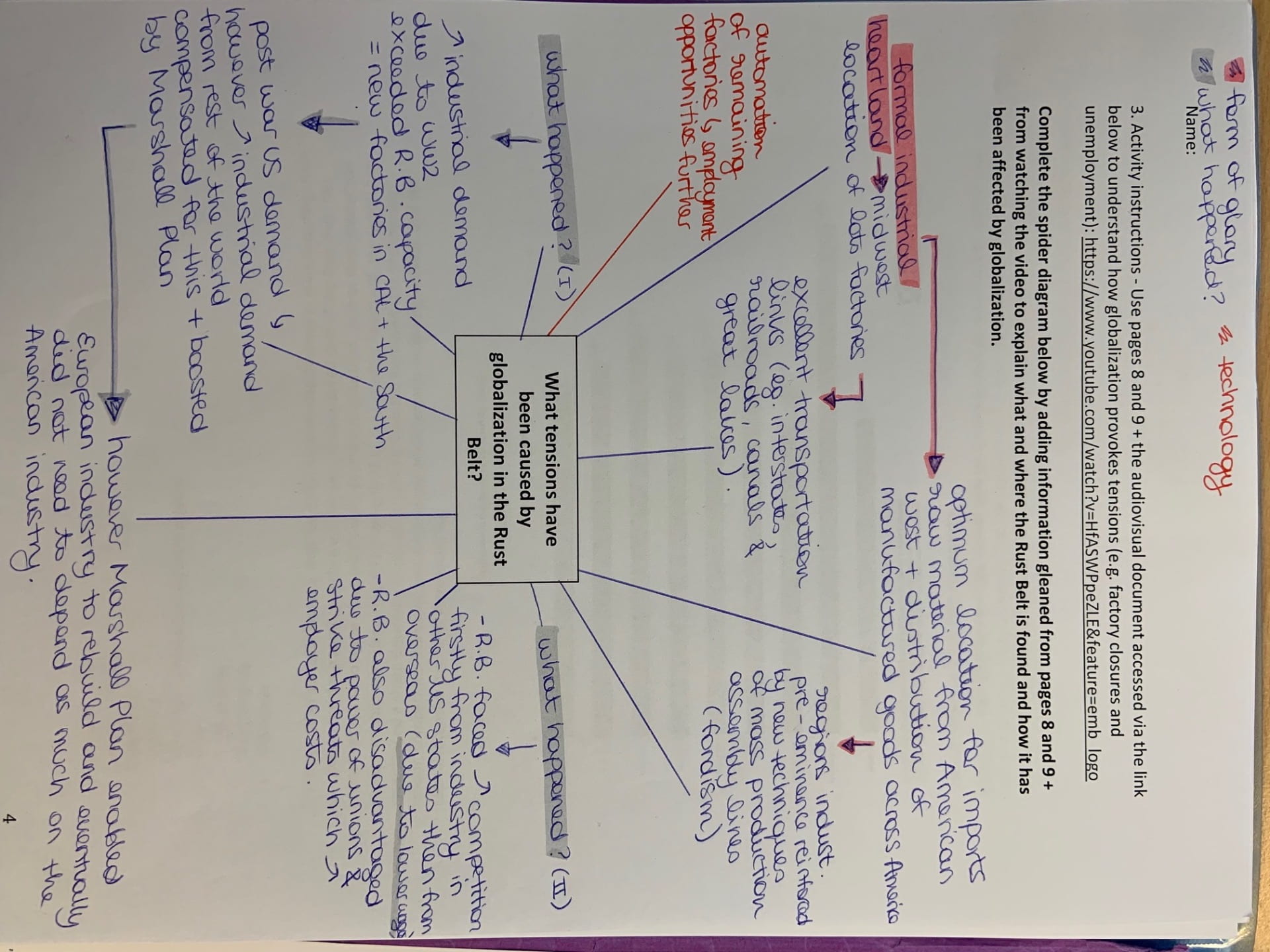
This case study examines how the territories of the US are not homogenous in terms of their integration into globalization. At a local scale this includes how localities, such as Detroit, are seen as not having benefited from globalization whilst others, such as NYC, are extremely well integrated into the wider global economy. It also approaches this issue at a regional scale in terms of the relative integration of the Rust Belt compared with the Sun Belt and concludes with a survey of the USMCA as an example of international cooperation.
Introductory video on US Geography:
Use this PowerPoint to learn about the US and globalization – it covers all major topics in the Chapter:
Question Spécifique: France: differentiated international influence and unequal attractiveness in globalization
France’s integration into globalization is highly uneven: while Île-de-France and aerospace-focused Occitanie function as global command and production hubs, former industrial regions such as Hauts-de-France or parts of Grand Est experience selective and often fragile integration, illustrating a territorial fragmentation of global attractiveness
Complex Dynamics: The European Union & Globalization France and the United States – Transborder Territories
•The opening chapter of Theme 3 explores the dynamics(forces, properties) that act upon and stimulate development & change in the European Union, particularly in regards to globalization.
•The theme concludes with case studies of the differing dynamics operating within French and USA cross border territories.
•French borders have been profoundly affected by the 1985 Schengen Agreement which today means 26 countries in Europe (but not all part of the EU) share open borders.
•The USA’s borders also been affected by two other agreements: the North American Free Trade Agreement (NAFTA) signed in 1994 and its successor the United States Mexico Canada Agreement (USMCA) signed in 2018.
The European Union – Key Points regarding integration into globalization and reducing territorial inequalities
General
27 member states.
The motto is ‘United in Diversity’.
Originally only contained 6 countries: Belgium, France, Germany, Italy, Luxembourg and the Netherlands.
The EU has a GDP of $22.5 trillion (estimated 2026), whilst India only has a GDP of $4.3 trillion (estimated 2025).
Core countries joined between 1957 and 1995. They have established economies, high levels of development, and sophisticated infrastructure and levels of service.
Peripheral countries joined between 2007-13. These are former Communist bloc countries with unstable economies, high levels of outmigration, weak economies, less developed infrastructure and lower level of service provision.
The EU also works on combating pollution and disease by providing cleaner water, more strict farming rules, and improving environmental conditions, among other methods.
The EU has also become a major trading power, providing 15% of global exports of goods and 20% of services. This is larger than the US (11% of goods and 18% of services).
The EU also provides over half of all development aid throughout the world
The Single Market
This is an EU policy which allows for the freedom of goods, people, capital and services throughout EU member countries.
It has led to significant reductions in prices of products and services, and migration throughout Europe.
‘Schengen’
No police or customs checks between EU countries at borders.
Police co-operation between countries.
Buy and bring back goods for personal use between EU countries.
International border control strengthened for inter-nation borders with non EU-members.
The Schengen Area consists of 29 countries, including four which are not members of the European Union – Iceland, Liechtenstein, Norway and Switzerland. Iceland and Norway are part of the Nordic Passport Union and are officially classified as states associated with the Schengen activities of the European Union.[18]Switzerland was allowed to participate in the same manner in 2008, and Liechtenstein in 2011.
Romania and Bulgaria are the newest members of the Schengen Area, with border controls lifted for air and sea travel on 31 March 2024 and land border controls lifted effective 1 January 2025,[19][20][21] more than 17 years after they acceded to the European Union.
The Common Agricultural Policy (CAP)
This was set up in 1962. Its basic aims were:
Create a single market in which agricultural products could move freely.
Make the EC (previous name) more self sufficient by giving preferences to EC products and restricting imports from elsewhere.
Giving financial support to EC farmers which included guaranteed prices (SUBSIDES) and therefore a guaranteed market.
Increase the average field size, farm size, and farmer’s income.
Taxes imposed on foreign imports so that prices cannot be undercut.
Supporters of the CAP say that it guarantees the survival of rural communities, where more than half of EU citizens live, and preserves the appearance of the countryside.
Critics say that as only 5% of EU citizens work in agriculture, which only generates 1.6% of GDP, the CAP costs too much.
Urban II Fund
Most Europeans live in urban areas because they are centres of economic activity and hold greater opportunities.
However, all cities have concentrations of social, environmental and economic problems.
Urban II Fund money comes from the European Regional Development Fund and it is for sustainable development in troubled districts of European cities.
It aims to provide economic and social regeneration.
Any successful idea in one city is shared with others to try and improve living conditions as widely as possible.
Social and economic regeneration includes:
Improving living conditions (e.g. renovating older buildings)
Creating new jobs in services that benefit the whole population
Integrating less favoured groups of people into education and training so that they can find satisfactory employment.
Developing environmentally friendly transport systems.
Making greater use of renewable energy.
Using the most up-to-date ICT systems to make work more efficient and to improve people’s skills and their job prospects.
For example: The town of Teruel in northern Spain has a new ring road, paid for by Urban II Funds. It will reduce traffic flows through the town by at least 20%, cutting congestion and improving travel times and air quality in the town. The new road also links previously isolated neighbourhoods. There are paths for cyclists and joggers. The project cost €16.6 million.
Interreg
Interreg is a key initiative of the European Union that connects countries, regions and communities through a series of funding programmes promoting cross-border, transnational, interregional and outermost regions cooperation.
Transborder regions in North America are not under a continental scale of governance, such as in the EU, thus border issues between the USA with Canada and Mexico are approached differently with immigration a major issue.